Pipeline
The budget void: when nobody asks where the money comes from
Deals advance for months on enthusiasm while the funding question goes unasked. What a real funding source looks like and how to ask without killing rapport.
By Rishi Patel, Founder & CEO, RevSage.ai · · 7 min read
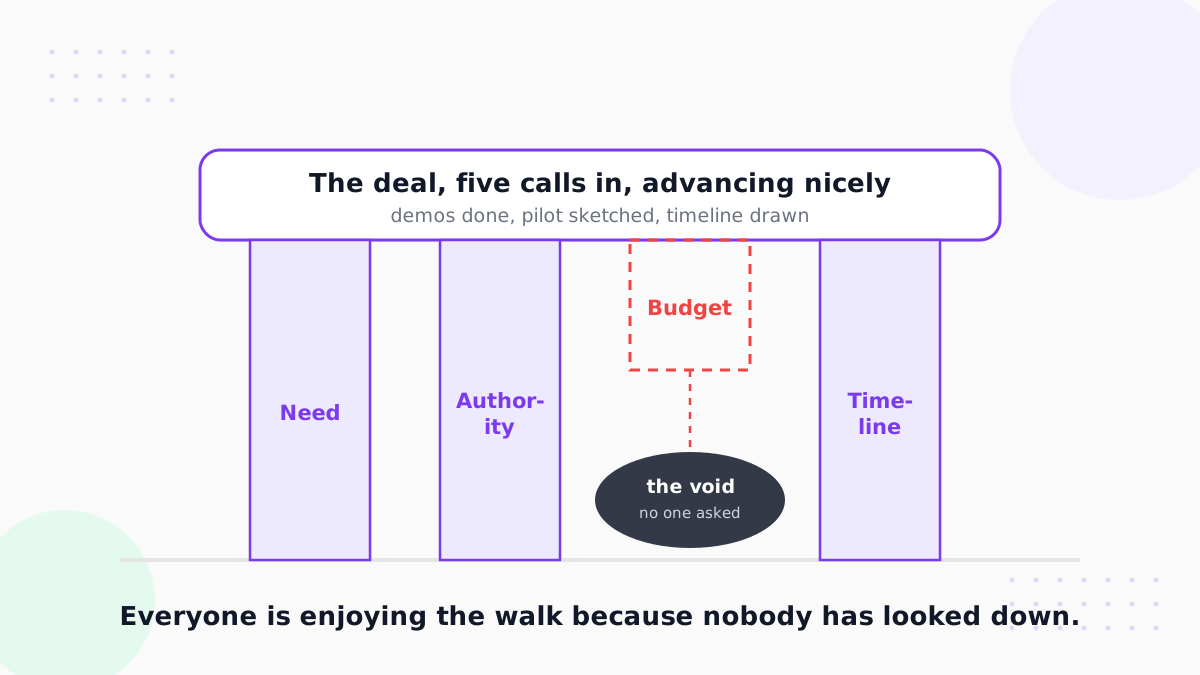
There's a deal shape I've seen enough times to recognize on sight. Four calls in, maybe five. Genuine engagement: the buyer shows up, asks sharp questions, brings a colleague to the demo. A pilot gets discussed. Timelines get sketched. And at no point in any recorded minute of the entire cycle has anyone established where the money would actually come from.
Not "did they say yes to the price." Earlier than that, and more basic: does a source of funds exist? An allocated amount, a budget line with this purchase's shape, a funding event, anything. When the answer is no, and nobody asked, the deal is advancing across a void, and every party is enjoying the walk because nobody has looked down.
The old qualification frameworks had a letter for this. Somewhere between BANT going out of fashion and "challenger" going in, asking about money early started to feel unsophisticated. I'd like to argue it's the opposite: the budget question, asked well, is one of the most respectful questions in sales, because it takes the buyer's time as seriously as your own.
Key takeaways
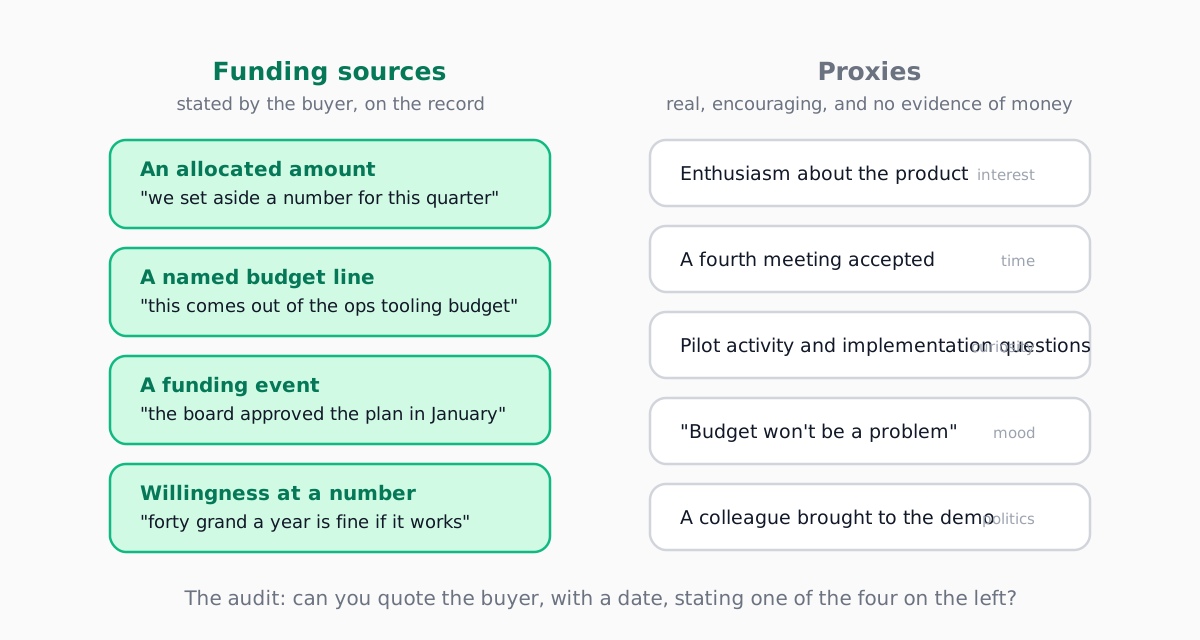
- A funding source is one of four things stated by the buyer: an allocated amount, a named budget line, a funding event, or explicit willingness at a specific number. Everything else is a proxy.
- Enthusiasm, meeting acceptance, and even pilot activity can all coexist with a total absence of money. Engagement measures interest, never capacity.
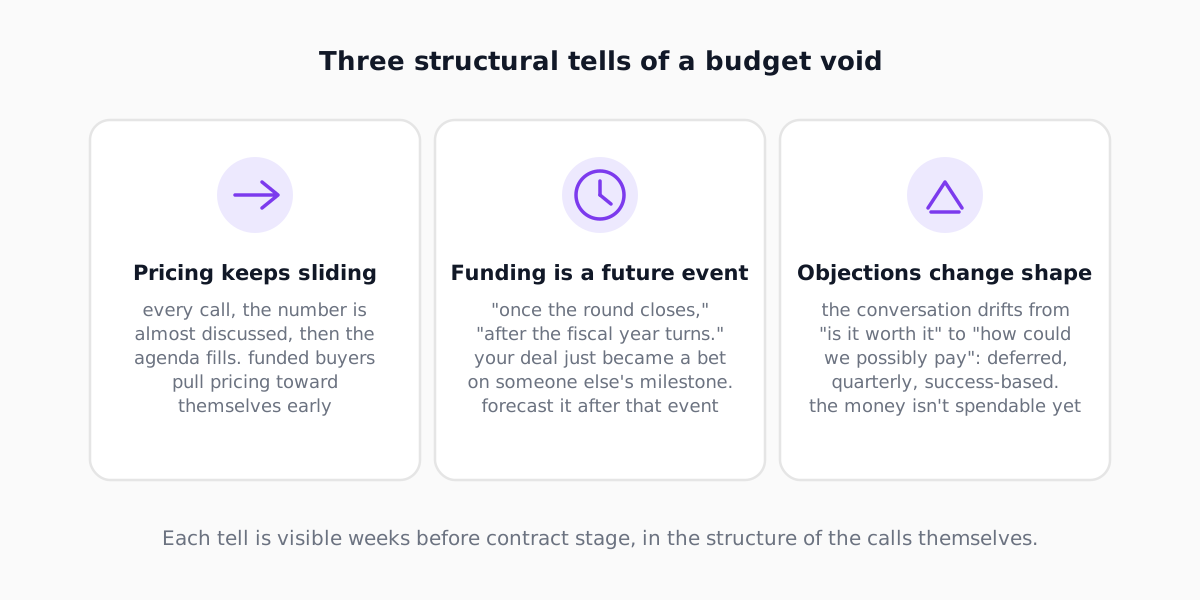
- Watch for the structural tells: pricing conversations that keep sliding, funding framed as a future event, and objections that mutate from price level into payment structure.
- The question lands fine when framed as planning: "for something in this range, where would the money come from, and who releases it?" Buyers with real funding answer easily.
- The most expensive version of this failure is discovering the void at contract stage, after months of mutual investment that a two-minute question would have redirected.
What a funding source actually is
Be strict about the definition, because everything downstream depends on it. A funding source exists when the buyer has stated at least one of:
An allocated amount. "We set aside a number for this next quarter." Best case. Rare.
A named budget line. "This would come out of the ops tooling budget." The money exists somewhere specific; the fight, if any, is over this purchase's claim on it.
A funding event. "The board approved the plan in January" or "the round closed last month." Money has arrived or will arrive on a date, and this purchase is inside its intended use.
Explicit willingness at a number. "If it does what you're describing, forty grand a year is fine." No formal line item, but a human with authority has attached a real figure to a real intention, out loud.
Now look at what's absent from that list: excitement about the product. Questions about implementation. Acceptance of a fourth meeting. A verbal "budget won't be a problem," which is a statement about mood, carries no number, no line, no event, and no name. Proxies, all of them. Real, encouraging, worth having, and worth exactly nothing as evidence that money exists.
The uncomfortable audit: for each deal in your pipeline, can you quote the buyer, with a date, stating one of the four? Not paraphrase. Quote. If your notes are too thin to answer, that's a different problem with the same fix, and it starts in discovery.
Why the question doesn't get asked
Three forces, usually braided together.
It feels rude early. The first calls are about their problem, their world, building trust. "Who's paying for this" seems like it belongs to a later, colder phase. So it waits. And each successive call makes it slightly more awkward to ask, because now it's admitting you didn't know.
Fear of the answer. A rep three weeks into a promising deal has an emotional position in it. The budget question is the one question that can vaporize the deal on the spot. Not asking preserves the deal in a quantum state: possibly funded, definitely still in the pipeline. Forecast reviews reward that ambiguity more than anyone likes to admit.
"Procurement handles that." In committee deals there's a genuine sense that money mechanics arrive with legal and purchasing at the end. But procurement negotiates the price of a funded purchase. It does nothing for an unfunded one, except discover the void late, expensively, and in front of everyone. That end-stage discovery is a big share of what gets logged as "lost to no decision," a category I looked at from the committee side in why healthy deals die.
There's a special case worth naming: founder-led and owner-led buyers. When the person across the table owns the P&L personally, the budget question and the runway question are the same question, and the emotional stakes are higher for them, which paradoxically makes reps even less likely to ask. Those deals produce the most dramatic voids, because there was never a budget line to point at, only a person's tolerance for spending their own money, which nobody wanted to make explicit.
The tells, while there's still time
Deals with a void underneath them do signal it, in structure rather than in words.
The pricing conversation keeps sliding. Every call, price is almost discussed, and then the agenda fills. Buyers with funded intent pull pricing toward themselves early, because they need it for their own internal math. A cycle where the number stays vague past the midpoint usually has a reason, and the reason is rarely good.
Funding is always a future event. Once the round closes. After the fiscal year turns. When the reorg settles. Each is possibly true, and each converts your deal from a purchase into a bet on someone else's milestone. A deal whose funding depends on an event should be forecast as closing after that event confirms, never before.
Objections mutate from level to structure. Early conversations were about whether the price was right. Suddenly the conversation is about how payment could work: quarterly, deferred, success-based, "starting smaller." Structure requests are often legitimate. A drift from "is it worth it" to "how could we possibly pay" is something else, and it's one of the clearest signals that the money doesn't exist in spendable form yet.
Asking without breaking anything
The trick, such as it is, is framing the question as planning rather than qualification. Qualification framing puts the buyer on trial: do you deserve my time? Planning framing puts you on their side of the table: let's make sure this can actually happen.
The version I've settled on, usually late in the second substantial conversation:
"For something in the range we've been sketching, where would the money come from on your side, and who besides you would have to be comfortable releasing it?"
Two questions in one sentence, deliberately. The first surfaces the source, or its absence. The second surfaces the person, the budget holder or approver who may never have appeared on a call, and whose absence from your contact map is its own risk worth knowing about.
Buyers with real funding answer this easily, often gratefully, because it moves the deal onto ground they've already prepared. Buyers without it will hesitate, generalize, or point at the future event. All three are answers. You're never worse off for having heard them in week three instead of month four.
And when the answer reveals a void, the deal doesn't have to die. It has to change shape. The work becomes helping your champion build the case that creates the budget line, which is exactly where a quantified cost of inaction earns its keep. Use their numbers, the ones they've already said out loud, and put the arithmetic where the budget holder will see it. That's the job our ROI calculator was built for, and it's a far better use of month two than three more demos.
For what it's worth, this is also a place where reading every call pays off mechanically. RevSage checks each deal for exactly this: whether any call contains a buyer statement establishing a funding source, and flags the deals advancing without one, with the receipts. It's the kind of absence a human forgets to notice, because nothing bad happened on any individual call. The void is only visible across all of them, and being able to say "searched every conversation since March, no funding source on record" turns a vague worry into a Tuesday-morning action item.
The question costs two minutes and one flicker of social discomfort. The void costs a quarter. I've stopped finding the trade difficult.
Frequently asked questions
- What counts as an established budget in a B2B deal?
- One of four things, stated by the buyer: an allocated amount, a named budget line this purchase draws from, a funding event such as a closed round or approved annual plan, or an explicit statement of willingness to pay at a specific number. Everything else, enthusiasm, meetings accepted, even a signed pilot, is a proxy that can coexist with zero available money.
- Why do salespeople avoid asking about budget directly?
- Three reasons show up constantly: it feels rude early, reps fear an answer that disqualifies a deal they like, and everyone assumes the money conversation belongs to procurement at the end. All three defer the question to the point in the cycle where a bad answer costs the most.
- What are the warning signs that a deal has no real budget behind it?
- The pricing conversation keeps sliding to the next call. The buyer talks about funding as a future event: once we close the round, after the reorg, when the new fiscal year starts. Or objections stop being about price level and start being about structure, like deferred payment or success-based fees, which usually means the money doesn't exist yet in any form.
- How do you ask the budget question without damaging rapport?
- Ask it as a planning question rather than a qualifying one: for something in this range, where would the money come from, and who besides you has to release it? Framed that way it reads as helping the buyer think through their own process, and buyers with real funding answer it easily. Difficulty answering is itself the information.
About the author
Rishi Patel, Founder & CEO, RevSage.ai. Rishi has spent 11 years building and scaling B2B SaaS companies, most of it obsessing over why some reps consistently read buyers right and most don't. He founded RevSage to give every rep the buyer intuition of their best teammate.