Pipeline
Why healthy deals die: the gap between CRM health and the committee
CRM health scores run on stage, close date, and activity counts a rep controls, while the deal's real state lives in buying committee dynamics no field captures.
By Rishi Patel, Founder & CEO, RevSage.ai · · 7 min read
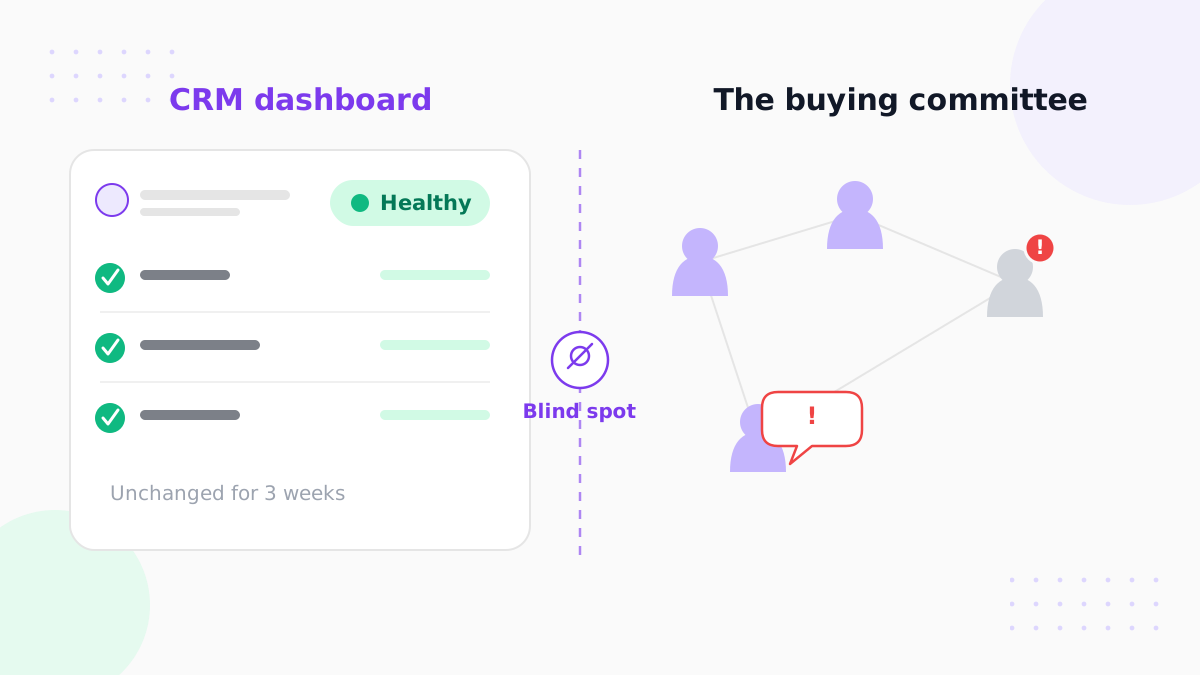
A deal can sit at 92 percent health in your CRM the week it dies. I've watched this happen enough times that it no longer surprises me, just frustrates me. The stage was current, the close date hadn't slipped, and the activity log was full of calls and emails, but none of it revealed that the actual budget holder had gone quiet three weeks earlier.
That gap, between what the CRM reports and what the buying committee is actually doing, is where good pipelines quietly bleed out. Rarely does a bad pitch cause it. Usually the cause is a scoring system built from fields a rep controls, applied to a decision made by people the rep barely talks to.
Key takeaways
- CRM health scores run on stage, close date, and activity count, fields a rep enters and can shade toward optimism. None of them measure what the buying committee actually thinks.
- Activity volume and buyer conviction are different things. A full call log can coexist with a committee that has already decided against you.
- Deals that die "healthy" usually trace to one of three causes: an unengaged economic buyer, an objection raised somewhere you never see, or a budget shift that has nothing to do with your pitch.
- Early signals of committee-level risk show up in behavior long before a stage or close date changes, if anyone is watching for them.
- Root cause analysis, working backward from a risk signal to the stakeholder and reason behind it, catches problems a lagging health score structurally cannot.
Why the health score turns green while the deal rots
CRM health scores exist because pipeline reviews need a number to argue about. The trouble is what feeds that number: stage progression, days since last touch, close date proximity, sometimes an activity count. Every one of those fields gets typed in, updated, or ignored by the rep running the deal.
None of them touch the negotiation happening on the buyer's side. Gartner has found that 77 percent of B2B buyers describe their most recent purchase as very complex or difficult, and most of that friction is internal: consensus-building among stakeholders a CRM field was never built to see.
Optimism bias runs the data entry
Reps aren't lying when they mark a deal "on track." They're doing what most people do with ambiguous information: filling the gap with hope.
A rep who spent three months earning a champion's trust wants that relationship to mean something, so a quiet week reads as "they're just busy," not "they've gone cold." The close date gets pushed by two weeks instead of pulled off the board, because moving it feels less final than admitting trouble.
Activity is not the same thing as progress
A busy activity log looks healthy. Five calls, twelve emails, a demo booked, all logged and dated. None of it tells you whether the buying committee moved an inch.
I've reviewed deals with more logged touches than deals that closed twice as fast, because volume was quietly substituting for traction. Activity measures effort. It says nothing about whether the right people are convinced.
A single thread reads as full engagement
The most common way a healthy-looking deal turns out hollow: every one of those calls and emails is with the same one or two people. The CRM has no field for who else is in the room.
Ebsta and Pavilion's 2025 GTM benchmark research found that closed-won deals carry roughly twice as many buyer contacts as closed-lost ones, and that multithreading lifts win rates by 130 percent on deals over $50,000. A rep working a single contact is already behind the base rate for winning, whether or not the health score agrees. I wrote a full breakdown of what multithreading actually takes in multithreading in B2B sales; the short version is that engagement with one person, however warm, is not engagement with the committee.
What actually kills a deal the CRM called healthy
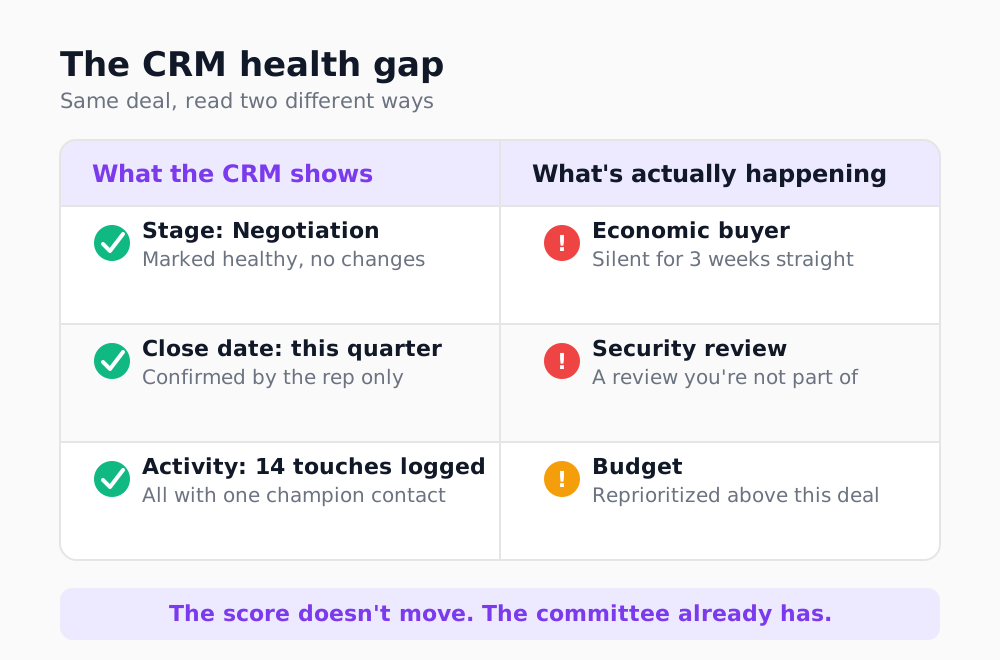
Three patterns account for most of the "how did we lose this" reviews I've sat through. None of them show up in a stage field.
An unengaged economic buyer. The person who signs the check has never been on a call. Your champion relays their reactions secondhand, so you end up negotiating with a summary of a summary. By the time that person weighs in directly, it's often to kill the deal rather than advance it.
Security or compliance objections raised in rooms you're not in. A security review, a data residency question, a procurement policy your champion didn't know existed. These conversations happen without you and only surface in your world as a sudden change of tone, usually after the outcome is already decided.
Budget re-prioritization above your deal's pay grade. A new initiative gets funded, a department's budget shrinks, a different vendor's renewal eats the discretionary spend your deal was counting on. None of it involves your product, and it can gut a "healthy" deal in a single afternoon.
This isn't the slow fade I wrote about in why deals stall. A stall usually announces itself through silence you can read over weeks. A committee-caused death can happen fast and quiet, right after a meeting you were never invited to, while your CRM still shows green because nobody updated the stage.
The early signals nobody logs in the CRM
None of these three causes are actually invisible. They're invisible to a system that only tracks stage, date, and activity count. Watch for the following instead.
| What you can observe | What it usually means |
|---|---|
| Economic buyer skips two or more scheduled calls in a row | Disengagement at the budget-authority level, not scheduling friction |
| Champion starts saying "I'll need to check on that" about topics they used to answer directly | A new stakeholder or process has entered the deal without you |
| A fast-moving deal suddenly needs "internal alignment" before the next step | Committee-level disagreement or a fresh objection has surfaced |
| Meeting attendees shift from business roles toward security, legal, or procurement titles | The deal has entered a review your CRM has no field for |
| Champion's language shifts from "we're moving forward" to "let me sell this internally" | The champion just discovered they don't have consensus |
Every one of these signals sits in your inbox, your call recordings, and your calendar. They rarely sit in the fields that generate a health score, which is exactly why a deal can look fine on the dashboard while it's already lost in the room. If you've ever wondered how much to trust a vendor's automated risk score on top of this, I broke that question down separately in what confidence scores in AI sales tools actually tell you.
Root cause analysis beats the lagging score
A health score answers one question: is this deal on track, based on what a rep entered. Root cause analysis answers a more useful one: which specific stakeholder is the risk, and why.
The method is simple to describe and harder to do consistently by hand. Start from a risk signal, an economic buyer's silence, a sudden request for alignment, a meeting that got smaller instead of bigger.
Trace that signal to the stakeholder connected to it. Then form a specific, testable hypothesis about the cause, whether that's a budget concern, an unresolved security question, or a competing internal priority. That hypothesis tells you what to do next, which a health score never does.
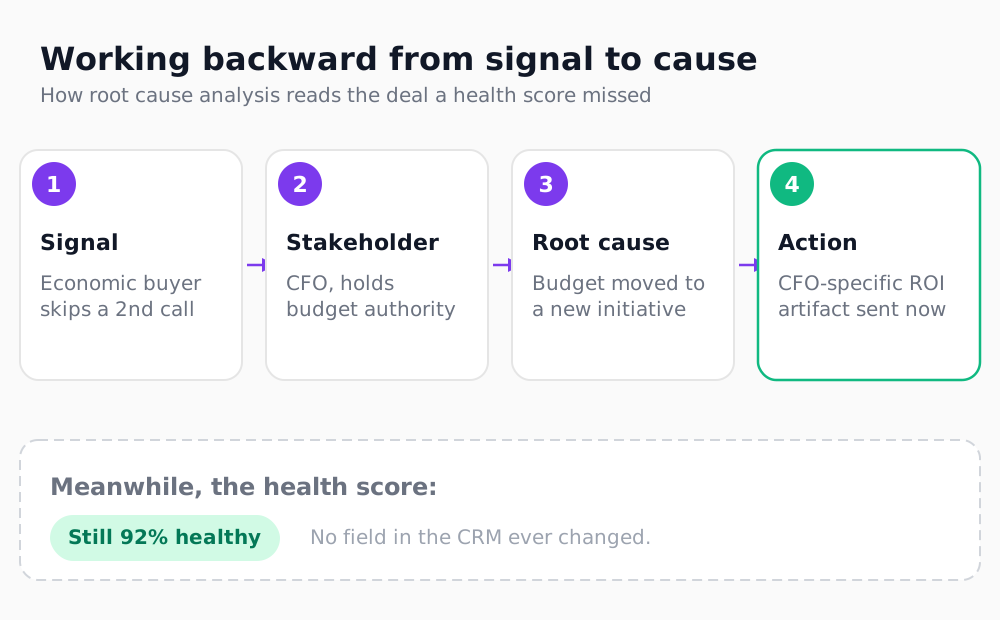
This is the exact gap we built RevSage.ai to close. It runs live root-cause analysis on every deal in the pipeline, reading the calls, threads, and meeting behavior a health score never touches, even what was unsaid in a room, and flags negative outcomes before they happen instead of after they show up as a stalled stage. Instead of a red or green label, a rep gets the specific stakeholder at risk and a hyperpersonalized artifact built to address that person's actual objection, delivered inside the CRM and comms tools reps already use. You can see how the mechanism works on the product page.
I'm biased here, obviously. I built this after watching too many "healthy" deals collapse for reasons that had been sitting in a transcript the whole time, never connected back to a name and a cause.
Running a pre-mortem before the deal dies
The single highest-leverage habit I've picked up across eleven years of building B2B SaaS: before a deal reaches the stage where a loss becomes official, run a pre-mortem. Assume it already died. Then work out why.
Gather whoever touches the deal and ask one question: if this closes lost in 60 days, what's the most likely reason, the honest one, not the hopeful one. Someone will usually say "the CFO never actually signed off" or "we never confirmed the security requirements" out loud, once you give them permission to stop defending the green score.
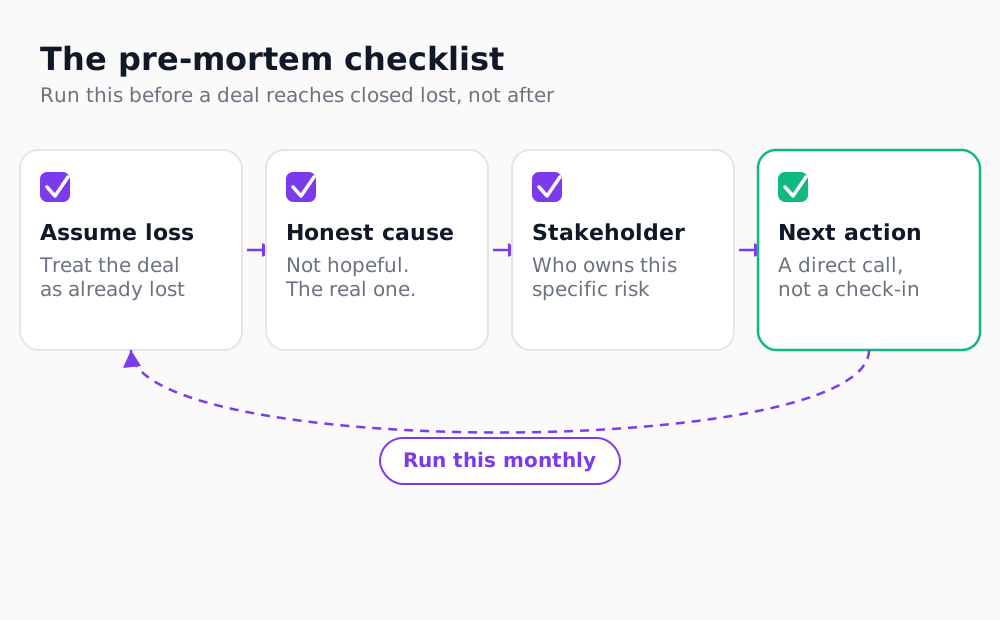
Turn each honest answer into a stakeholder and a next action, not a vague reminder to check in. If the worry is an unengaged economic buyer, the action is getting that person on a call this week, not sending another deck to the champion. If the worry is a security review you can't see, the action is asking directly who owns it and offering to shortcut it.
Run this monthly on anything past the midpoint of your pipeline. You'll start catching the deals that were never as healthy as the dashboard claimed. The score will still say green. You'll know better, and for once, you'll know why.
Frequently asked questions
- Why do deals die late in the sales cycle even when the CRM shows them as healthy?
- Health scores are built from fields a rep controls: stage, close date, and activity count. None of those fields capture what the buying committee is doing without the rep in the room, so a deal can carry a green score right up to the week the economic buyer declines to sign. The score was never measuring the committee's actual state, just the rep's activity and optimism.
- What is a deal health score and what does it actually measure?
- A deal health score is a CRM-generated composite, usually built from stage progression, days since last activity, close date proximity, and email or call volume. It measures how a rep has been interacting with a deal, not how the buying committee feels about the purchase. Two deals with identical scores can carry very different real risk if one has an engaged economic buyer and the other doesn't.
- How accurate are CRM forecasts compared to what actually happens in a deal?
- Forecast accuracy drops fastest on committee-heavy, high-consideration purchases, the exact deals that lean hardest on lagging fields. Gartner research on the B2B buying journey found 77 percent of buyers describe their most recent purchase as very complex or difficult, driven mostly by internal consensus-building a CRM never records. A close date entered six weeks ago is evidence a rep typed a date, not evidence the deal will close on it.
- What is root cause analysis in B2B sales?
- Root cause analysis in sales means working backward from an observed risk signal, such as a stalled reply or a skipped meeting, to the specific stakeholder and reason behind it, rather than reading a generic composite score. It replaces the question 'is this deal healthy' with a more useful one: which stakeholder is at risk, and why.
- How do you spot an unengaged economic buyer before it kills the deal?
- Watch for absence, not only presence. An economic buyer who never joins a call, never replies directly, and is only referenced secondhand by your champion is a live risk even when every other stakeholder seems enthusiastic. Track direct engagement specifically: has the person with budget authority ever spoken, in their own words, about the purchase?
About the author
Rishi Patel, Founder & CEO, RevSage.ai. Rishi has spent 11 years building and scaling B2B SaaS companies, most of it obsessing over why some reps consistently read buyers right and most don't. He founded RevSage to give every rep the buyer intuition of their best teammate.