Buyer Psychology
What science actually says about personality-based selling
DISC and MBTI promise to decode buyers. The evidence supports something narrower. What research validates, what it debunks, and how to profile responsibly.
By Rishi Patel, Founder & CEO, RevSage.ai · · 8 min read
At a sales kickoff a few years back, I watched a rep open a deal review with "the buyer's a high D, so I'm keeping emails to three lines." Reasonable instinct. Then the buyer spent forty minutes of the next call asking methodology questions no textbook Dominance profile would predict, and the rep, anchored to the label, read genuine curiosity as a stall.
I founded a company that builds psychological profiles of buyers, so you might expect a full-throated defense of personality selling from me. You won't get one. After 11 years in B2B SaaS, my honest read is that half of what gets taught under this banner has real evidence behind it, and the other half is astrology with a corporate license fee.
The frustrating part is that the defensible half genuinely works. So let's separate the two: what the research supports, where the science gets thin, and how to use personality insight without letting a four-letter label run your deal.
Key takeaways
- Adaptive selling, meaning changing your approach based on what you observe in each buyer, has strong meta-analytic support.
- Fixed typology labels rest on weak science. As many as half of MBTI retakers get a different type within five weeks.
- What a buyer does (response speed, question style, channel choice, meeting behavior) tells you more than any static label.
- Used well, a personality profile is a directional hypothesis you update with evidence, never a script you perform.
- AI profiling widens what you can observe, and it inherits the same rule: directional, improvable, never certain.
Why frameworks feel so right
DISC, MBTI, and their cousins solve a real emotional problem for salespeople: ambiguity. A buyer is a stranger making a high-stakes decision through behavior you can barely see. A framework compresses that stranger into something nameable, and naming things reduces fear.
Frameworks also give teams a shared vocabulary, which has genuine value. "She's analytical, lead with the data" is a faster conversation than three paragraphs of nuance. The certification industry around these tools adds a scientific glow: assessments, scores, official-sounding dimensions.
There's a quieter reason they spread, too. A type description flatters everyone a little and indicts no one, which is also how horoscopes survive. Psychologists call these Barnum statements: descriptions vague enough to feel personal while fitting nearly anyone.
I've sat through enough sales kickoffs to watch the cycle repeat. A trainer types the room in twenty minutes, everyone laughs at how accurate their card feels, and for two weeks every pipeline review features reps confidently diagnosing strangers. By month two the cards are coasters. The vocabulary outlives the discipline.
None of that makes frameworks useless. It does mean popularity is no evidence of accuracy, so it's worth asking what the research actually shows.
What the research actually supports
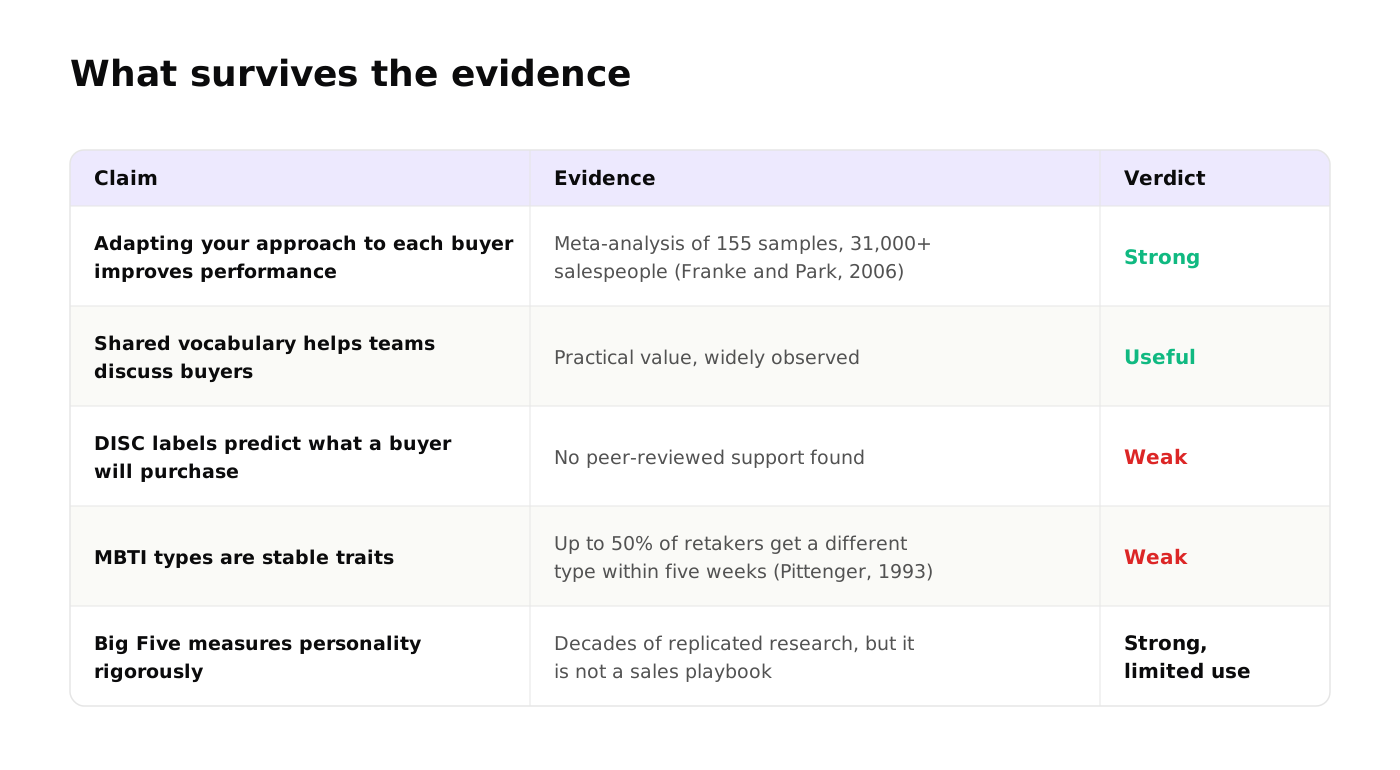
Strip away the branding and one practice stands on solid ground: adaptive selling. Spiro and Weitz formalized it in 1990 with the ADAPTS scale, which measures how much salespeople alter their approach across and within customer interactions (Spiro & Weitz, Journal of Marketing Research).
The evidence held up at scale. A 2006 meta-analysis by Franke and Park, pooling 155 samples and more than 31,000 salespeople, found that adaptive selling behavior improved self-rated, manager-rated, and objective performance measures (Franke & Park, Journal of Marketing Research).
Read those findings closely, though. The science validates the practice of adapting: noticing differences between buyers and adjusting in response. It says almost nothing about which labeling scheme you use to organize the observations. The evidence crowns the verb. The industry sold us nouns.
Practitioners knew this before the journals did. Every team has one rep who closes buyers the others bounce off, and when you shadow that rep you never hear a typology. You hear someone changing pace, depth, and proof points for each room.
Where the science gets thin
MBTI carries the most documented problems. The instrument forces continuous traits into binary letters, so a person scoring near the middle of a dimension can flip categories on a tiny score change. Pittenger's review found that even with a five-week retest interval, as many as 50% of people land in a different type the second time (Pittenger, 1993). For a tool whose premise is stable type, that result is disqualifying.
DISC fares better as a communication aid and worse as a crystal ball. Even its publishers generally position it for self-awareness and team communication rather than prediction. I have found no peer-reviewed evidence that a buyer's DISC label predicts what they will purchase, and I have looked hard, because finding it would be commercially convenient for me.
If you want the model personality psychologists actually defend, look at the Big Five, which measures traits as continuous dimensions rather than buckets and has held up across decades of research. Notice what the sales training industry did with it: almost nothing. Continuous scores resist tidy playbooks, and tidy playbooks are what sells at kickoff.
The pattern across typologies is consistent: useful vocabulary, weak measurement, and almost no validated link from label to buying behavior.
Behavior is the better signal
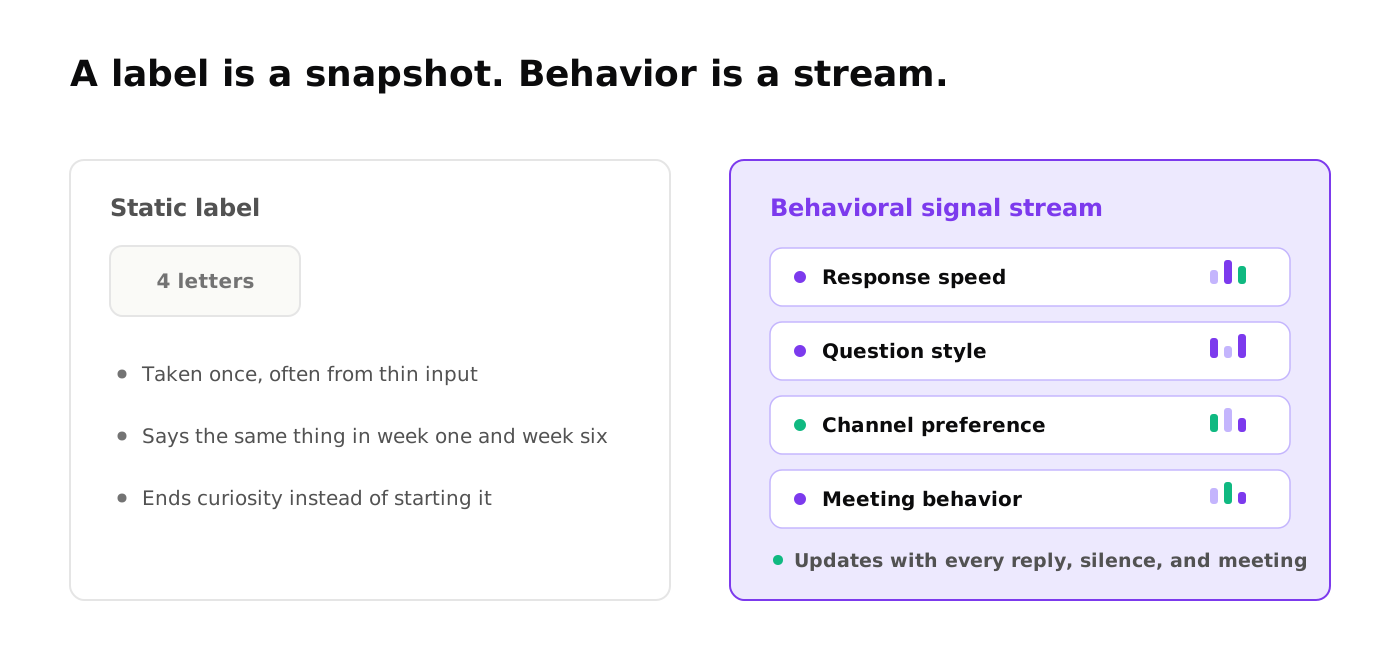
A label is a snapshot, usually taken once, often from thin input. Behavior is a stream, and streams update.
Consider what a buyer shows you in any active deal:
- Response speed. Replies in minutes signal a different relationship to the decision than replies in weeks, and a sudden change matters more than either baseline.
- Question style. Risk questions ("what happens if this fails?") and vision questions ("what could this become?") come from different decision postures and deserve different answers.
- Channel preference. The buyer who answers email in one line but talks for an hour on the phone is telling you where to make your case.
- Meeting behavior. Who they bring, whether they read the deck beforehand, whether they push back early or save objections for the end. All of it is signal.
Watching beats testing for a simple reason: the buyer never agreed to be typed, but they volunteer behavior constantly. A read assigned from observed behavior in this deal, revised when the behavior changes, will outperform a type inferred once from a questionnaire or a LinkedIn photo.
Here's what that looks like in practice. Last spring I watched a deal where the economic buyer had replied within the hour for three straight weeks, then shifted to four-day silences right after the security review. A label would have said the same thing in week one and week six. The behavior change said everything: a new stakeholder had entered with veto power. The rep who noticed re-ran discovery and closed. Another rep on the same team, facing an identical silence and explaining it as "high I, probably just busy," lost his deal that quarter.
Frameworks still earn a place as shorthand for the patterns you observe. We use four decision styles ourselves as a working vocabulary, and I've broken down how in the four buyer types in B2B deals. The difference is what feeds the label.
How to use personality insight responsibly
Five rules I hold our own product to, and that any rep can apply by hand:
- Treat every profile as a first draft. It is a hypothesis about how this buyer decides, held loosely.
- Update on contact. Every reply, every silence, every meeting either confirms the draft or revises it. A profile that hasn't changed after six weeks of contact is a profile nobody is reading.
- Adapt format, never substance. Shorter emails, more data, a call instead of a thread. Your actual case should survive any personality.
- Never let the label end curiosity. "She's a driver" is a reason to ask sharper questions, never permission to stop asking.
- Keep it falsifiable. Write down what behavior would prove your read wrong. If nothing could, you're doing astrology again.
There's an ethical floor under all five. Adapting how you communicate respects the buyer. Using a profile to exploit insecurity or manufacture false rapport poisons the relationship, and buyers can smell it faster than most reps believe.
Where AI profiling fits, and where it stops
Here I'll talk about our own work, with the same skepticism applied. Software can read more signal than any rep has time to gather: public writing, role history, how someone phrases questions, how quickly they respond and on which channel. At RevSage.ai we compile that into a psychology dossier for each buyer, with a recommended next message and channel, and the thinking behind that approach is laid out on our buyer intelligence page.
Now the honest limits. Our design target is roughly 80% directional accuracy from public data alone, improving when a buyer completes an assessment and sharpening as a deal generates real interaction data. That is a design target, never a guarantee about any individual. No system reads minds, no profile is a lie detector, and a vendor claiming certainty about a human being is selling you the weak half of this field with better fonts.
Directional means the dossier gets the broad decision style right often enough to change what a rep tries first, the way a forecast changes whether you carry an umbrella. You still look at the sky.
Run inside the five rules above, the value compounds. The machine drafts the hypothesis faster and from more evidence than a rep could collect alone, and the rep stays the scientist. Why any of this moves deals in the first place is a longer story, and I've told it in buyer psychology in B2B sales.
Every profile is a first draft
The best reps I've worked with watch buyers instead of typing them. Adaptive selling earned its evidence base because adjusting to observed behavior works, inside any framework or none.
So keep the vocabulary if it helps your team talk. Drop the certainty. Let every label survive only as long as the buyer's behavior keeps agreeing with it, and you'll capture what personality selling always promised without the fiction it usually ships with.
Frequently asked questions
- Does personality-based selling actually work?
- The adaptive part works. A 2006 meta-analysis covering more than 31,000 salespeople found that adapting your approach to each buyer improves performance on self-rated, manager-rated, and objective measures. The weak part is rigid typing: there is little evidence that assigning buyers a fixed label predicts purchasing behavior.
- Is DISC scientifically valid for sales?
- DISC is useful as a shared vocabulary for communication styles, and even its publishers generally position it for self-awareness rather than prediction. There is no strong peer-reviewed evidence that a buyer's DISC type predicts buying decisions. Treat a DISC read as a hypothesis to test, never a script to follow.
- Why do psychologists criticize the MBTI?
- The most documented problem is test-retest reliability: studies have found as many as 50% of people receive a different four-letter type when retested within about five weeks. The instrument also forces continuous personality traits into binary categories, so people near the middle of a dimension flip types on small score changes.
- How accurate is AI personality profiling for sales?
- Current tools produce directional intelligence rather than verdicts. RevSage.ai's design target, for example, is roughly 80% directional accuracy from public data, improving when buyers complete an assessment and as a deal produces real interaction data. No profiling system is certain about an individual, and every output should be updated against observed behavior.
About the author
Rishi Patel, Founder & CEO, RevSage.ai. Rishi has spent 11 years building and scaling B2B SaaS companies, most of it obsessing over why some reps consistently read buyers right and most don't. He founded RevSage to give every rep the buyer intuition of their best teammate.